A paper cup blank make-or-buy review compares ready-to-form fan blanks with the complete work needed to produce equivalent blanks internally. Comparing the purchase price of blanks with the cost of raw board omits printing, cutting, waste, quality control and inventory. Begin with technical scope before evaluating project economics.
This is an operational comparison framework, not a profitability forecast or investment recommendation. Use your own verified costs and demand. No public machine prices, payback periods or supplier performance guarantees are assumed. Confirm material and artwork compatibility with each process supplier.
Decision worksheet
| Decision area | Purchased blanks | In-house converting |
|---|---|---|
| Material identity | Supplier lot and declaration | Board purchasing and traceability |
| Artwork | Approved print and revision | Prepress, print control and changeover |
| Cut geometry | Incoming verification | Tooling, registration and inspection |
| Inventory | Order quantity and lead time | Board, work in process and finished blanks |
| Quality ownership | Supplier agreement and receiving control | Internal process control and disposition |
Define an equivalent delivered blank
Specify drawing revision, board construction, coating, print file, grain orientation, packing method and acceptance criteria. Confirm whether the purchased blank offer includes printing and delivery to the same point used in the in-house comparison. Separate sidewall blanks from bottom-stock supply because they follow different material paths.
Keep food-contact documentation and intended-use evidence under the applicable buyer and regulatory process. A successful forming trial does not replace those records. If one route uses a different board or coating, first establish technical suitability; a cost comparison between non-equivalent inputs cannot support a reliable procurement decision.
Map every activity in the internal route
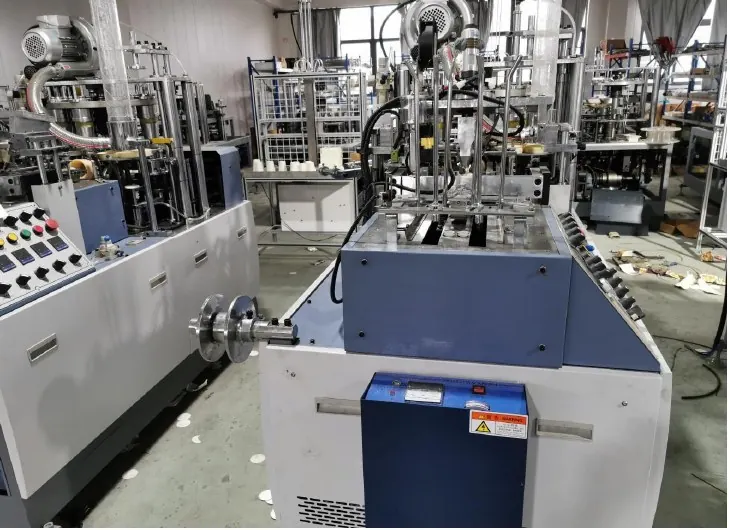
List board receiving, storage, conditioning, printing, drying or curing where applicable, cutting, stripping, stacking, inspection, packing and transfer to forming. Record supporting utilities, handling equipment, floor space, staffing and maintenance. Do not assume the forming-machine operator can absorb these tasks without a workload assessment.
Identify the controlling capacity for each product family. An internal converting line that is adequate on average may struggle with frequent artwork changes or small orders. Retain setup and cleaning demand separately from sustained running output so the order mix can be tested against real available time.
Normalize quantities and losses
Compare cost per accepted usable blank at the agreed boundary. Separate raw material issued, process waste, rejected print, cutting losses and accepted output. Credit usable returns only when their recovery is demonstrable. Keep overhead allocation and marginal operating decisions distinguishable so the worksheet answers the intended question.
For an illustrative quantity example, 100,000 candidate blanks at a combined accepted yield of 95% provide 95,000 usable blanks. Supplying 100,000 accepted blanks at that same assumed yield requires about 105,264 candidates after rounding up. The assumed yield is only an example; establish your own staged losses and avoid applying them twice.
Evaluate responsiveness and supply exposure
Record approved minimum order quantities, replenishment lead time, artwork-change responsiveness and emergency supply arrangements for purchased blanks. For internal production, record board and ink availability, tooling lead time, specialist staffing and recovery from a converting-machine outage. Neither route is automatically more resilient.
Evaluate obsolete artwork stock and slow-moving designs as separate risks. A lower apparent unit cost on a large batch can increase unusable inventory when customer artwork changes. Test the comparison using the real SKU mix and demand variability, and identify which assumptions would reverse the operational preference.
Design a reversible qualification path
Consider a qualified secondary source or a limited product-family trial before changing the entire supply model. Keep incoming inspection and forming acceptance consistent between routes. Record who approves artwork, material substitution and defective-lot disposition, including ownership of retained samples and complaint evidence.
Send HANNAI the intended cup range, blank drawings, board constructions, order mix and current supply boundary when discussing compatible equipment. Ask for a coordinated printing, cutting and forming review if internal converting is being considered. Preserve open assumptions rather than presenting an untested route as a validated production solution.
Related equipment and next checks
Review the paper cup production line and the related guide to paper cup blank die-cutting guide. The Engineering Notes archive connects these checks with wider machine planning.
Frequently asked questions
Is raw board cost enough for an in-house comparison?
No. Include the complete route to accepted usable blanks.
Can both supply routes be used?
Yes, if each route is technically qualified and traceable for its approved scope.
Does in-house production always reduce lead time?
No. Board, tooling, staffing and internal queues can still constrain response.
What is the correct quantity denominator?
Accepted usable blanks at the same agreed delivery boundary.
Review the evidence with HANNAI
Send your cup range, fan-blank drawings, material constructions, SKU mix and current supply boundary. These details support a coordinated converting and forming review.