Paper cup machine vacuum-source maintenance should verify whether the installed pump or generator can provide stable suction at the required event, not merely whether it makes noise or shows an unloaded reading. Restricted filters, unsuitable service condition, leakage, worn components or changing duty can reduce usable capacity. This guide separates source health from the downstream pickup faults covered elsewhere.
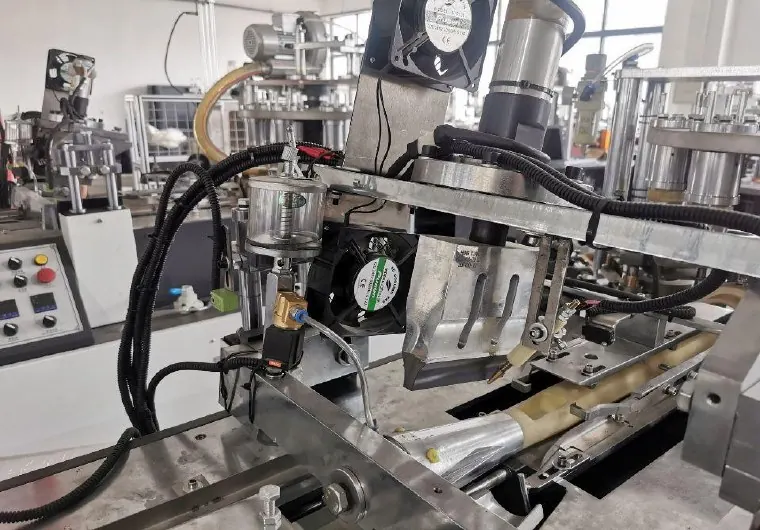
Identify the installed vacuum source and duty
Use the machine pneumatic diagram, component nameplate and manual to identify whether negative pressure comes from a mechanical pump, liquid-ring or oil-lubricated arrangement, dry pump, venturi generator or another supplied device. Record its electrical or compressed-air supply, inlet path, filters, separator, exhaust, reservoir and connected functions.
Do not apply a generic pump service interval. Lubricant, filter type, safe venting, temperature limits and maintenance steps depend on the actual component and operating environment.
Define the failure under production demand
Record missed pickup, delayed release, unstable gauge behavior, longer recovery, abnormal noise, heat, exhaust contamination or an alarm. Note cup or blank format, machine speed, number of active vacuum functions, runtime, recent service and whether the fault is worse after a stop or during simultaneous events.
The vacuum pickup system guide follows the circuit to the material contact point. Confirm first whether the symptom begins at the source or only at one branch.
Use a vacuum-source evidence table
| Observed condition | Evidence to inspect | Diagnostic direction |
|---|---|---|
| Slow vacuum recovery | Inlet restriction, reservoir, leakage, duty and source condition | Separate reduced capacity from increased demand |
| Only one pickup point fails | Branch hose, valve, fitting, filter and suction element | Inspect the local path before the pump |
| Source runs hotter or louder | Ventilation, filter condition, lubricant where applicable and mechanical evidence | Stop and review source health |
| Capacity falls as production continues | Runtime trend, temperature, filter loading, leakage and simultaneous use | Compare cold and stable operating states |
| Fault began after maintenance | Part identity, flow direction, seals, connections and service record | Verify reassembly and compatibility |
Isolate the source and release stored vacuum
Stop through the approved sequence, apply lockout and verify electrical, pneumatic and mechanical isolation. Vent receivers and trapped negative pressure according to the manufacturer procedure. Pumps, belts, fans and hot surfaces can remain hazardous after the machine stops.
Never open an oil reservoir, separator or filter housing while pressure, vacuum or heat remains. Use appropriate contamination control and protective equipment specified for the component and process materials.
Inspect filters, separators and inlet condition
Check filter identity, flow direction, seating, seals, contamination and replacement record. Inspect transparent bowls or indicators only as the design permits. Paper dust, coating residue, liquid carryover or a collapsed element can restrict flow and also indicate an upstream housekeeping problem.
Do not remove a filter permanently to restore suction. The filter may protect the source and finished-product environment. Replace with the approved element and investigate abnormal loading frequency.
Service the pump by its documented method
Where the source uses lubricant, verify approved type, level, condition, leakage and change procedure. Where it is dry-running, do not introduce oil or cleaning fluid unless explicitly allowed. Inspect mounting, cooling air, drive components, hoses and exhaust condition without dismantling beyond factory authorization.
Abnormal particles, odour, discoloration, repeated overheating or mechanical noise require component-specific review. A higher setting or longer run time should not replace maintenance of a deteriorating source.
Measure capacity at comparable operating states
Use approved measurement points and calibrated instruments. Record idle source level, recovery time or flow evidence, then compare the loaded event at the same product, speed and connected-function condition. A strong closed-port reading can coexist with inadequate flow through a restricted or leaking circuit.
If compressed air drives a venturi source, compare dynamic supply at the event and use the compressed-air leak and demand guide. Do not classify factory pressure and vacuum performance as the same measurement.
Separate source capacity from circuit leakage
Use controlled isolation of documented branches only where the procedure permits it. Compare source behavior with and without the suspected branch, then inspect valves, fittings, hoses and pickup seals. Avoid clamping hoses or blocking ports with improvised objects.
A source that recovers normally when one branch is isolated may be healthy, while a source that remains slow across known-good boundaries needs further source-side review. Record every test boundary so results can be repeated.
Prove pickup and product quality after service
Restore housings, guards, filters and connections, account for tools and follow the documented restart. Monitor noise, temperature, alarms and vacuum behavior through controlled speed stages. Stop if the service condition deteriorates again.
Run labeled blanks or cups and count misses, doubles, drops and late releases. Keep the source measurement, component identity, intervention and production result together in the maintenance record.
Frequently asked questions
Does a normal vacuum gauge prove sufficient pickup capacity?
No. Gauge location, restriction, recovery time, leakage and actual flow during the pickup event all affect usable performance.
Can a dirty filter simply be removed during production?
No. Use the approved replacement element and investigate why it loaded. Removing protection can damage the source or contaminate the process.
Should pump oil be topped up with any similar product?
No. Where lubricant is used, follow the component specification and compatibility procedure. Some vacuum sources are designed to operate without oil.
What information helps supplier diagnosis?
Provide source nameplate data, circuit drawing, filter and service history, comparable loaded measurements, noise or temperature evidence and the pickup symptom.
Send the machine model, installed vacuum-source identity, filter and service history, safe measurement records, connected functions and affected samples through our inquiry page. HANNAI can review the evidence for the delivered system.