Choose a hamburger box machine from the unfolded blank, board specification, box geometry, adhesive, required output and upstream die-cutting workflow.
Define the box before comparing machines
“Hamburger box” can refer to several structures, dimensions and closure styles. Prepare an approved erected box, an unfolded blank and a dimensioned drawing. Mark fold lines, locking areas, glue positions, board grain direction and any ventilation or cut-out features.
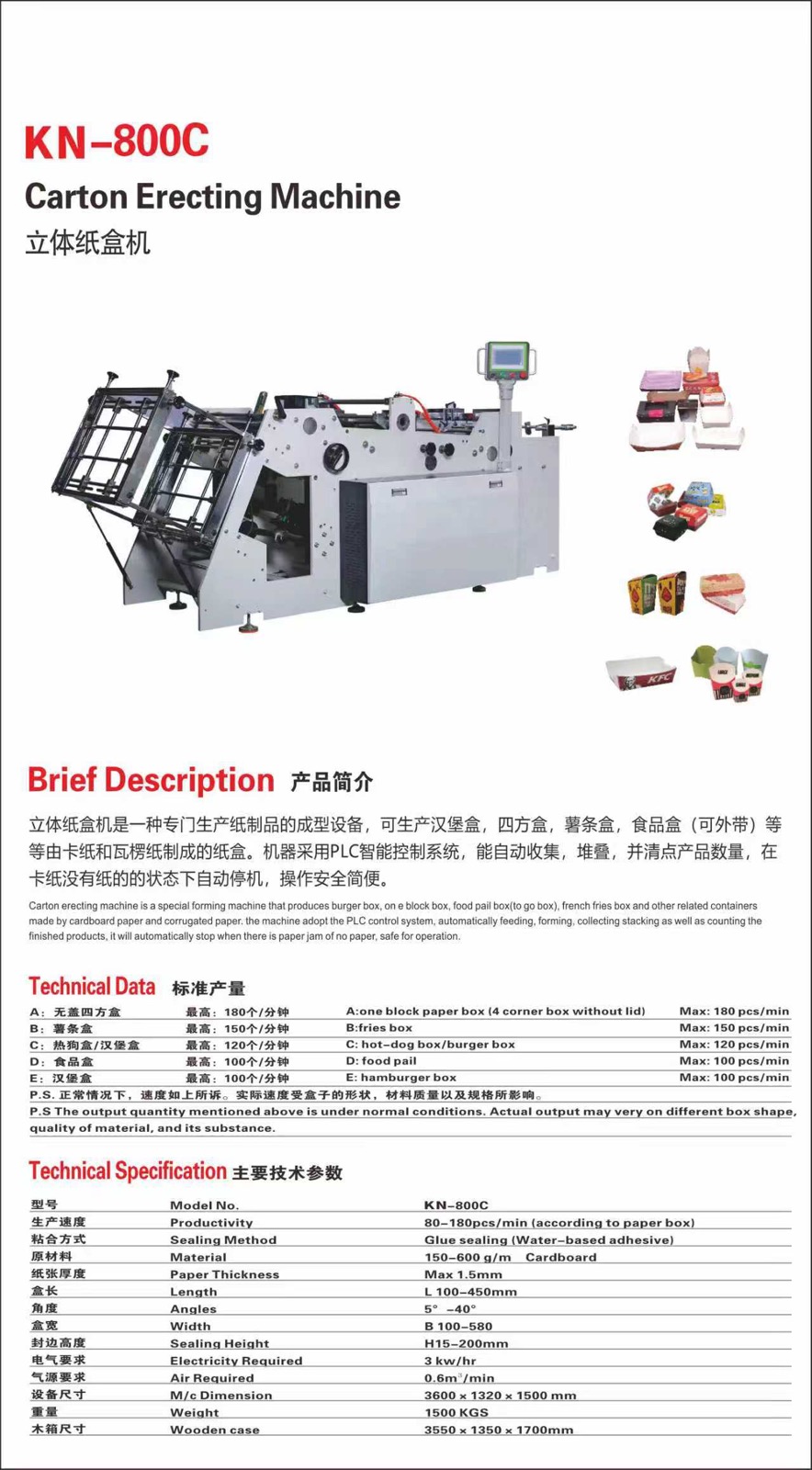
State whether the first product is a burger box, fries box, hot-dog box, food pail or another one-piece carton. The HANNAI KN-800C hamburger box machine page lists the reference applications and machine data for quotation discussion.
Build a product and process checklist
| Project item | What to send | What it helps confirm |
|---|---|---|
| Box structure | Erected sample, flat blank and dimensioned drawing | Feeding, tooling, folding and sealing route |
| Board | Material name, GSM, thickness, coating and grain direction | Sample suitability and feeding setup |
| Adhesive | Approved glue and application requirement | Sealing process and quality checks |
| Output | Demand by box type, shift hours and order size | Practical capacity and changeover plan |
| Blank supply | Purchased blanks or in-house printing and die cutting | Upstream equipment and quality ownership |
| Factory | Voltage, air supply, layout and destination country | Installation and quotation scope |
Check the KN-800C reference range against the sample
The current KN-800C reference identifies an output range of 80–180 pieces per minute depending on box type. Reference maxima vary by product: one-block paper boxes up to 180 pieces per minute, fries boxes up to 150, hot-dog or burger boxes up to 120, and food pails or hamburger boxes up to 100.
These figures are comparison references, not a promise for every box. Final output depends on the approved blank, material, box structure, adhesive, setup and acceptance method. Ask the supplier to state which sample and test condition support the quoted target.
Confirm board and thickness with a production sample
The KN-800C reference lists 150–600 g/m² cardboard and a maximum paper thickness of 1.5 mm. Material within a numerical range can still behave differently because of stiffness, coating, moisture, print finish, creasing and grain direction.
Provide a representative production batch for testing rather than only a small hand-cut sample. Store blanks flat and protected from moisture or deformation. Feeding instability caused by curled or inconsistent blanks should not be confused with the machine’s normal capability.
Evaluate blank accuracy before carton erecting
Die-cut dimensions, crease depth and alignment affect how the blank opens, folds and seals. Inspect the flat blank before it reaches the forming machine. A poorly prepared blank can produce skewed corners, incomplete folds or inconsistent glue contact even when the erecting equipment is adjusted correctly.
If blanks will be prepared in-house, compare the drawing and roll width with suitable roll die-cutting equipment. Printing registration and die cutting must be controlled as one upstream process.
Define the adhesive and seal acceptance
The reference sealing method uses water-based adhesive. Confirm the approved adhesive, application position, setting condition, storage requirement and food-packaging documentation with the relevant suppliers. The erected box should remain secure through stacking, filling, closure and normal takeaway handling.
Agree on how glue continuity, squeeze-out, open seams and contamination will be inspected. A faster cycle has little value if boxes must be reworked or if the seal opens after packing.
Plan output by product mix
A factory producing one stable box can plan differently from a converter running many short orders. List monthly demand by box type, batch size, shift pattern and expected change frequency. Include blank loading, glue replenishment, cleaning, inspection and carton packing when estimating sellable output.
If several products are planned, identify the launch product and the next two priorities. This makes tooling and acceptance scope clearer and prevents an early quotation from assuming that every future shape is included.
Review utilities, space and operator access
The current reference lists 3 kW/hr required power, 0.6 m³/min air, machine dimensions of 3600 × 1320 × 1500 mm and a weight of 1500 kg. Confirm the final nameplate, voltage, frequency, connection details and utility quality for the ordered machine.
The layout needs additional room for blank staging, operator access, glue handling, product discharge, quality checks and maintenance. Do not use machine footprint alone as the factory-space requirement.
Specify an acceptance test
Use the approved blank, board and adhesive. Record machine identity, setup, test duration, formed quantity, accepted boxes, rejects, stops and adjustments. Inspect geometry, fold position, seal security, appearance, stacking and compatibility with the customer’s filling process.
Repeat the test for each box included in the purchase scope. A successful burger-box run does not automatically approve a fries box or food pail with different geometry.
Frequently asked questions
What should I send for a hamburger box machine quotation?
Send an erected box, flat blank, dimensioned drawing, board specification, GSM, thickness, adhesive requirement, target output, voltage, air conditions and destination country.
Can one machine make burger boxes and fries boxes?
The KN-800C reference includes multiple food-box types, but each structure and size must be confirmed separately. Ask what tooling, setup and test are required for every planned product.
Is the highest reference speed available for every box?
No. Reference output varies by box type, and production performance also depends on the blank, material, adhesive and test conditions.
Do I need die-cutting equipment?
Not if consistent finished blanks are purchased from a qualified supplier. In-house die cutting may be considered when volume, design control, lead time and economics justify the additional process.
Send your box sample, flat-blank drawing, board specification, target output and factory utilities through our inquiry page. HANNAI can review the carton erecting and upstream blank workflow.