A paper cup servo encoder battery warning needs a planned maintenance response, not an improvised battery swap. In a battery-backed absolute feedback system, position information may be lost if the backup path is interrupted incorrectly. A machine that starts without an alarm is not automatically correctly referenced.
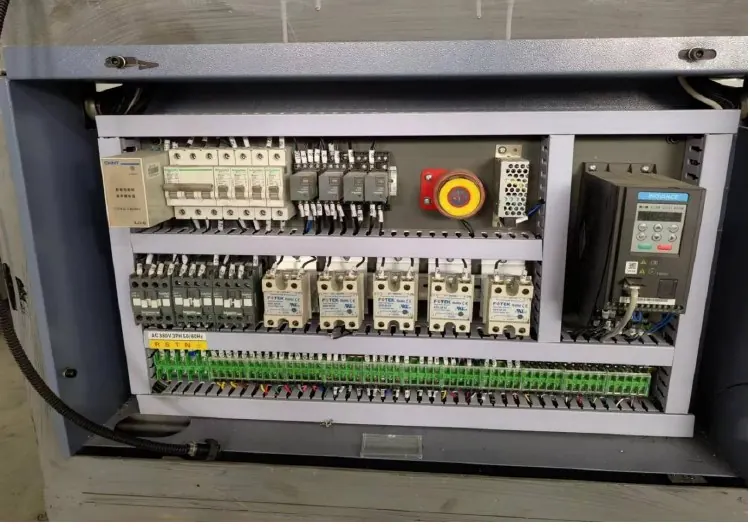
Confirm that the installed axis actually uses battery-backed absolute feedback. Batteryless and incremental systems differ. This guide concerns axis-position retention, not PLC program-memory batteries. The cabinet image provides electrical-system context and does not identify a particular encoder battery.
Diagnostic decision table
| Observed state | Decision | Evidence needed |
|---|---|---|
| Low-battery warning only | Plan the specified replacement | Exact alarm and axis identity |
| Absolute position already lost | Use authorized reference recovery | Controller and mechanical reference |
| Several axes share a battery unit | Identify every affected axis | Battery-unit wiring diagram |
| Position changed after maintenance | Stop before production | Before-and-after coordinate record |
Identify the complete feedback architecture
Record motor, encoder, amplifier and controller model numbers, not just the machine name. Determine where the battery is connected and whether one unit supports several axes. Ask for the exact maintenance manual revision matching that hardware. Similar connectors do not establish interchangeability.
Save the alarm history before acknowledging it. Distinguish a battery warning from an absolute-data error, cable disconnection or communication alarm. These events lead to different recovery requirements. A warning that disappeared after a restart still belongs in the maintenance record because it can identify an intermittent backup connection.
Preserve the reference evidence before intervention
Back up the approved drive parameters and machine recipe through the normal service process. Record the current displayed coordinate, reference status and documented mechanical reference marks. A parameter backup may not contain the encoder position data needed to restore the machine relationship.
Identify adjacent axes and tooling that could collide if the coordinate system is wrong. Support gravity-loaded or stored-energy mechanisms according to the maintenance procedure. Photographs help explain the arrangement, but photographs alone are not an approved homing or alignment method. Arrange supplier assistance before replacing a battery if the recovery procedure is missing.
Follow the exact replacement power-state procedure
Have qualified personnel determine the safe power and motion state from the installed equipment instructions. Some manufacturers prescribe specific power conditions to preserve data; that does not authorize generic energized cabinet work. If the specified procedure cannot be performed safely, stop and obtain an approved service plan.
Use the approved battery assembly with the correct chemistry, connector and identification. Do not substitute a household cell, charge a non-rechargeable pack or improvise a temporary parallel supply. Retain the removed pack identity and follow the applicable battery disposal route. Avoid moving the motor shaft during the operation unless explicitly required by the authorized procedure.
Separate alarm clearance from reference recovery
Mitsubishi documentation describes absolute-position systems and their model-specific battery and recovery requirements. Use it only when applicable to the installed system. An alarm reset does not demonstrate that the controller coordinate still corresponds to the tooling position.
If absolute data has already been lost, do not enter an arbitrary zero because the tooling appears close to home. Follow the machine supplier reference-setting procedure, including any axis synchronization and mechanical checks. Keep production inhibited until that process is complete. Restoring a drive setting from another machine can introduce an incorrect direction, ratio or reference offset.
Validate retention and safe motion independently
Use the approved staged commissioning sequence with guards and protective functions restored. Compare coordinate, reference status and the permitted initial movement with the saved evidence. Check the relationship to neighboring stations before allowing automatic cycles. Stop immediately if motion direction or station timing differs from the approved expectation.
Where the manual requires a power-cycle retention test, perform it in the specified safe state and compare the resulting coordinate and alarms. Record battery part number, replacement date, affected axes and the verification outcome. Send HANNAI that record if reference recovery was necessary; it separates a battery service event from a persistent encoder, wiring or mechanical fault.
Related equipment and next checks
Review the HN-M100 forming machine and the related guide to encoder and home-position signals. The Engineering Notes archive connects these checks with wider machine planning.
Technical reference
- Mitsubishi Electric servo absolute-position system documentation — general reference; confirm applicability to the installed equipment.
Frequently asked questions
Does every servo encoder need a battery?
No. Identify the installed feedback technology first.
Does a PLC backup preserve absolute motor position?
Not necessarily; the retention paths may be separate.
Can a warning be ignored until position is lost?
Plan service under the applicable manual before a loss forces recovery.
Is an alarm-free restart sufficient?
No. Verify the machine reference and approved motion relationship.
Review the evidence with HANNAI
Send your machine model, component identification and the observations described in this guide. Include the drawing or material reference and any before-and-after measurements so the required next check can be identified.