A print-mark sensor provides a repeat reference; it does not define bag length by itself. Artwork pitch, film stretch, encoder scaling, feed slip, sensor response and cut offset determine where the seal and cut land around the printed design.
Calibration should use the production film and controlled samples. This guide does not prescribe a universal mark color, size or numeric offset. Match the installed sensor manual, PLC/HMI logic and approved packaging artwork.
Decision matrix
| Calibration input | Evidence | Purpose |
|---|---|---|
| Artwork | Repeat pitch, mark dimensions, color and clear zone | Defines the intended optical target |
| Film condition | Material, print lot, transparency, tension and stretch | Controls real mark presentation |
| Sensor | Model, light mode, teach method, spot and response | Provides stable edge detection |
| Motion reference | Encoder/pulse scaling, roller condition and feed slip | Converts motion to bag length |
| Output position | Seal/cut datum, offset and repeated pack samples | Approves finished placement |
Control the artwork and film lot
Obtain the approved artwork repeat and print-mark specification. Measure actual repeat on conditioned film samples and mark machine direction. Inspect background variation, varnish, transparent areas and neighboring graphics that could create false contrast.
Do not redesign the mark at the machine without artwork control. A sensor can teach to an unintended edge and appear stable during one roll. Keep a known-good film sample for setup comparison.
Set the optical target correctly
Clean the lens and reflective target where applicable. Set working distance, spot position and orientation from the sensor manual. SICK guidance shows that print-mark recognition depends on contrast change and that mounting direction can matter on difficult or transparent material.
Use the model-specific teach or threshold method with the real mark and background. Observe output across several repeats at setup speed. Confirm one clean transition per repeat rather than relying only on the sensor indicator at a stationary mark.
Verify feed measurement and mechanics
Inspect drive roller cleanliness, nip pressure, film tension and tracking. Record encoder source, pulse scaling and effective feed diameter where relevant. Slip or stretch can change cut position even while sensor detection is correct.
Compare commanded and actual movement over several repeats using a controlled measurement. Do not correct mechanical slip with a growing electronic offset. Use the linked film guide to resolve tracking, tension and cutting-path causes.
Set bag length and cut offset separately
Confirm whether the control uses mark-to-mark following, nominal length with mark correction, or another mode. Record bag-length setting and cut/seal offset as separate parameters. Preserve the previous recipe before changes.
Run several packs and mark sensor edge, seal and cut positions relative to the artwork. Change one parameter at a time. Confirm that offset correction does not move the seal onto print or reduce the required package margin.
Validate across speed and roll conditions
Test at controlled increasing speeds and sample after startup, steady running and a stop/restart. Observe print placement, bag length, seal integrity, cut edge and sensor alarms. Include the beginning and later portion of a roll where tension can differ.
Record film lot, sensor settings, recipe, encoder evidence and sample measurements. Send HANNAI the artwork repeat, sensor label, film photos and marked packs when requesting calibration support.
Technical references
- SICK register sensor operating principles — general component guidance; the installed machine documentation remains controlling.
Related machine and guide
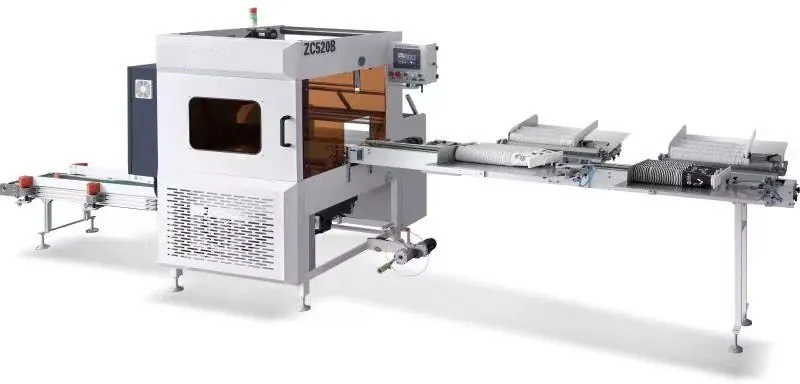
Review the paper cup packing machine for machine context, then use the film feeding, tracking and cutting guide for the adjacent check. Browse all Buyer Guides when building a wider project checklist.
Frequently asked questions
Does reliable mark detection guarantee correct bag length?
No. Encoder scaling, feed slip, film stretch and control mode also affect length and cut position.
Can the sensor be taught from one stationary mark?
Use the model procedure and verify repeated dynamic transitions on the real film.
Should cut offset correct film tracking drift?
No. Resolve tracking and feed mechanics before compensating electronically.
What trial samples are useful?
Keep startup, steady-speed, stop/restart and later-roll packs with measured artwork, seal and cut positions.
Review your machine configuration with HANNAI
Send the machine model, project reference, component labels, drawings, photos and a description of the required result. We will clarify which details must be confirmed before a quotation or technical recommendation.