Paper cup packing machine product-infeed and jam troubleshooting starts before the film section. Cups that arrive tilted, nested too tightly, counted in an unstable group or released at the wrong moment can collide at a guide and create a downstream sealing or cutting alarm. Clearing the visible jam without locating the first loss of product control usually makes the fault return.
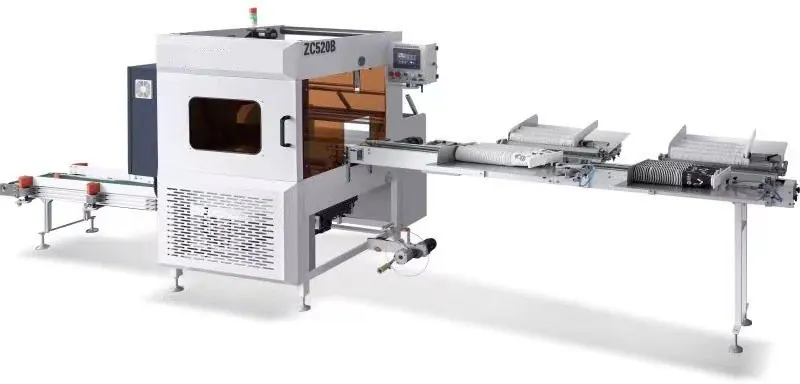
Map the first product-control failure
Preserve the cup sequence immediately before a stop. Mark the jam location, cup format, stack or batch count, speed state, alarm order and whether the fault follows startup, acceleration, reel change or cup-size changeover. A safe external video can show whether one cup arrives late, rotates, rebounds or catches a guide.
Separate forming-line output from packing-machine behavior. Use the cup collection and counting troubleshooting guide when the packer receives unstable counts or poorly controlled stacks. The packer cannot consistently correct an upstream handoff that already varies.
Classify the jam by its repeatable pattern
Useful categories include a single tilted cup, two cups entering together, an over-compressed stack, a batch that opens during transfer, a cup lip catching one guide, product entering the film at an angle or a fault that repeats after a fixed number of cycles. Keep good and jammed product for comparison.
Inspect cup dimensions, rim shape, sidewall seam, nesting behavior and contamination. A cup-format or quality change can alter friction and stack height even when the packer settings have not moved. Do not widen guides until the product is confirmed against the approved sample.
Use an infeed evidence table
| Observed pattern | Evidence to inspect | Diagnostic direction |
|---|---|---|
| One cup tips at the same guide | Guide surface, cup rim, entry angle and local clearance reference | Check cup geometry, burrs, contamination and alignment |
| Two cups enter together | Separator movement, sensor sequence, product friction and timing | Review de-nesting and release control |
| Jam follows a batch release | Count, stack compression, pusher motion and downstream readiness | Check batch handoff rather than film cutting |
| Good at low speed, unstable after acceleration | Cycle video, motion completion, vibration and product recovery time | Review timing margin and mechanical support |
| Fault begins with a new cup format | Approved sample, recipe, guide positions and changeover record | Confirm the complete format setup |
Clear jams with full isolation
Stop and lock out the machine according to the delivered procedure. Release stored pneumatic or spring energy and wait for heated sealing components to reach a safe condition. Never reach through a guard, defeat an interlock or pull a cup from an energized nip.
Before removing product, photograph its orientation and the first contact point. Inspect guides, belts, pockets, pushers and transfer surfaces for coating residue, film fragments, burrs, loose hardware or wear. Preserve reference marks before moving a guide or support.
Verify product, guides and release timing as one system
Compare the jammed cups with the approved format for top diameter, height, rim condition and stack behavior using the site’s controlled method. Check that the correct recipe and change parts are installed. Confirm guides support the product without excessive squeezing and that the stack can move freely when the machine is isolated.
From outside the guarded area, compare separator, pusher, gate and downstream-ready signals during an authorized slow cycle. Do not change sensor position and mechanical timing together. Preserve the original reference and use the supplier’s procedure for any adjustment.
Separate infeed faults from film-section faults
A product can be correctly grouped but still meet film that is wrinkled, off-center or late. Conversely, a film-tracking alarm may be the final event after a tilted cup disturbed the web. Use the film feeding, tracking and cutting guide only after identifying which event occurred first.
Preserve alarm history and compare cup position, film position and sealing readiness in one timeline. This avoids adjusting the film path to compensate for a product handoff problem.
Run a staged confirmation
Restore guards, remove tools and restart through the authorized setup stages. Run a small identified batch, then a longer sequence that includes the condition where the jam previously appeared. Record consecutive accepted packs and any near-jam behavior rather than only the absence of a stop.
Verify pack count, cup condition, film presentation, seal quality and downstream handling. Retain the changeover and corrective-action record for the next production shift.
Frequently asked questions
Should the guides be widened when cups keep jamming?
Not before checking cup geometry, recipe, change parts, contamination and the first contact point. Excess guide clearance can create new tipping and tracking problems.
Why does a packing jam appear only with one cup supplier or lot?
Rim shape, dimensions, coating friction, sidewall seam and nesting behavior can change the product handoff. Preserve labels and compare an approved sample under the same machine condition.
Can an operator pull out the jam and press reset?
Only after following the machine’s isolation and jam-clearing procedure. Reaching into guarded infeed, pusher, film or sealing areas while energy remains is unsafe.
What evidence should be sent to the supplier?
Send the packer model, cup drawing and samples, pack count, change-part and recipe references, first alarm, jam-location photos, safe cycle video and recent format changes.
Send the packing-machine configuration, cup dimensions, pack count, changeover record, alarm order and safe sequence evidence through our inquiry page. HANNAI can review the handoff from finished cups to the packing section.