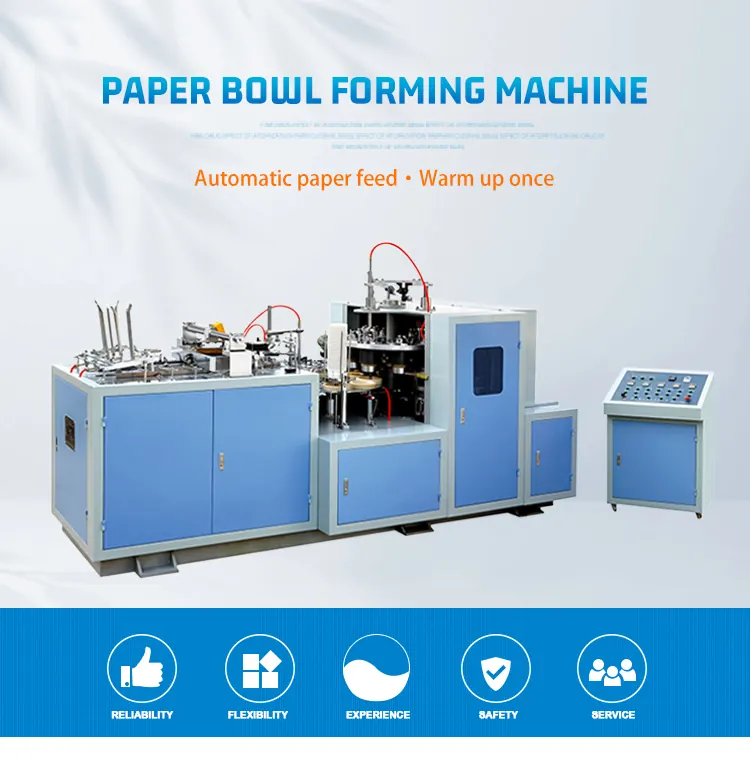
Paper bowl machine bottom-disc feeding and sealing faults must be separated before settings are changed. A missing, doubled, skewed or damaged disc is a presentation problem; a correctly placed disc that leaks, wrinkles or separates is a sealing-system problem. Because bowl construction, material and heating or bonding method vary, diagnosis starts with the approved bowl drawing and delivered machine process.
Define the bottom construction
Record bowl drawing revision, bottom-disc dimensions, sidewall and bottom material, coating sides, grain or orientation information where relevant, and the intended sealing structure. Confirm which machine stations punch, feed, form and seal the bottom for the supplied configuration. A nominal capacity label does not define these relationships.
The paper bowl forming and transfer guide covers the broader process. This guide focuses on the disc from its prepared input through base-seal verification.
Classify the first abnormal condition
Separate no disc, two discs, off-center disc, folded edge, incorrect orientation, damaged disc, incomplete forming, visible channel and a leak with no obvious external mark. Record the first affected cycle, machine state, material lots, speed stage, alarm and bowl position. Keep the disc and bowl together where possible.
A leak found after filling may originate at the side seam, bottom seam, damaged coating or handling mark. Dry and mark the exact leak location using the factory’s approved test procedure. Do not declare the bottom station responsible until the path is localized.
Use a bottom-process evidence table
| Observed symptom | Evidence to collect | Diagnostic direction |
|---|---|---|
| Disc missing or doubled | Feed input, pickup action, detection, stack or roll condition and cycle | Review separation and sequence before sealing |
| Disc consistently off center | Disc dimensions, guide references, transfer position and tooling seating | Separate incoming geometry from machine presentation |
| Wrinkle at one orientation | Sidewall overlap, disc orientation, forming contact and mapped samples | Find asymmetric material or tooling relationship |
| Leak begins after material change | Both material lots, coating sides, dimensions and approved setup | Confirm compatibility before increasing process input |
| Leak is intermittent after stops | Restart sequence, first bowls, controller evidence and utility state | Review transient process and presentation conditions |
Inspect bottom material preparation
If discs arrive pre-cut, inspect dimensions, roundness, edge quality, coating, blocking, curl, dust and lot identification. If the machine prepares bottoms from a roll, inspect roll identity, slitting, feed stability, punch evidence and scrap. Use the supplier-agreed conditioning and sampling method.
Do not widen a feeder or increase vacuum to compensate for stuck, curled or out-of-size discs. Compare a known accepted lot under the same setup. The bottom-roll preparation guide provides related material-control principles, but the bowl drawing and actual machine instructions remain the reference.
Verify single-disc feed and position
Observe from outside guards as the disc is separated, picked, transferred and located. Record sensor indications, actuator completion and the point where the disc first shifts. A correct final position cannot be assumed from a normal feed alarm state. Use approved marked samples if orientation tracing is needed.
After lockout and verified isolation, inspect accessible pickup surfaces, vacuum paths or mechanical separators where fitted, guides, pockets, stops, fasteners and sensors. Control stored pneumatic and spring energy. Clean or replace parts only through the supplier procedure and confirmed part identity.
Inspect forming and sealing interfaces
With the machine safely isolated and at a safe temperature, inspect accessible bottom tooling, knurling or forming surfaces, supports, heating components where fitted and locations that contact the disc. Look for paper or coating buildup, damaged edges, uneven wear, looseness, impact marks and residue.
Heating, pressure, dwell, ultrasonic or other process details depend on the supplied design. Qualified personnel should compare controller status, sensor integrity, utilities and mechanical references with the released recipe. Do not raise temperature or force beyond the approved setup to cover an off-center disc or damaged tool.
Use destructive samples to locate the cause
Where the factory procedure allows, open or section labeled bowls to examine disc position, overlap, formed profile and sealing evidence. Compare accepted and rejected samples at the same orientation. Record before disassembly so the relationship to the external leak is not lost.
Check sidewall seam position relative to the bottom symptom. An overlap or coating interaction may create an orientation-specific channel. Use several consecutive samples, because one apparently good bowl between failures can reveal an intermittent feed or restart sequence rather than a fixed tooling dimension.
Verify with controlled leak and handling tests
After approved correction, remove tools, restore guards and follow the documented restart. Inspect first-off discs and bowls for position, base profile, wrinkles, surface damage and dimensions. Apply the agreed leak test with specified liquid, fill condition, dwell and observation method defined by the buyer’s quality plan.
Also check stacking, denesting and downstream handling. A base that passes an immediate leak test may still be visibly deformed or unstable. Record material lots, recipe, tooling, intervention, sample size and result. Release only through the responsible quality decision.
Frequently asked questions
Does every bottom leak require more heat or pressure?
No. Missing or skewed discs, material mismatch, coating damage, contamination, tooling condition and utility faults can create leaks. Localize the defect first.
Can a paper cup bottom setting be copied to a paper bowl?
No. Geometry, material and machine configuration may differ. Use the approved bowl recipe and confirm changes with the supplier.
Is one filled-bowl test enough after repair?
No. Use the defined sampling and test plan, including consecutive bowls and relevant restart conditions, then inspect other product characteristics.
What evidence should be sent for a recurring bowl leak?
Provide bowl and disc drawings, material lots, mapped leak samples, opened base photos, first-fault sequence, recipe evidence, tooling photos under isolation and test method.
Send the machine model, bowl and bottom drawings, material details, event sequence, labeled leak samples, isolated tooling photos and test record through our inquiry page. HANNAI can review the evidence against the supplied bottom-forming process.