Paper cup machine chain, cam and drive timing maintenance protects coordinated movement between feeding, forming, transfer and discharge stations. The objective is not to make isolated parts “tighter,” but to preserve the machine’s approved relationship, lubrication, clearances and safe motion.
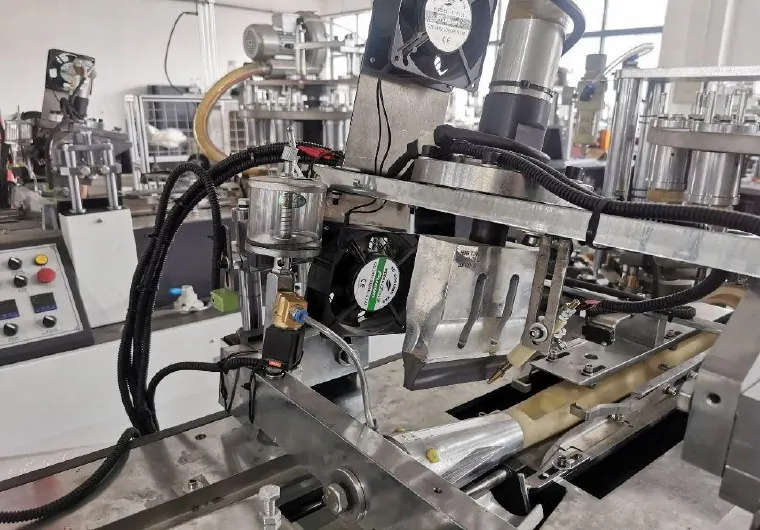
Understand timing as a machine-wide relationship
A chain, cam, gear, shaft, coupling or servo-driven axis transfers movement to a defined station. Wear or movement at one point can appear elsewhere as missed pickup, collision risk, poor transfer, unstable forming or repeated stops.
Do not adjust timing from the defective cup alone. Confirm the machine reference position, affected station, direction of movement, upstream and downstream events, and whether the issue is mechanical, electrical or material-related.
Use a drive-system inspection table
| Control point | Evidence to inspect | Decision question |
|---|---|---|
| Reference | Home position, marks, drawing and station sequence | Is the machine at the approved reference? |
| Chain and sprocket | Tension, alignment, wear, lubrication and fasteners | Is motion transferred without abnormal slack or binding? |
| Cam and follower | Surface, roller rotation, clearance and contact pattern | Is the designed motion being followed smoothly? |
| Shaft and coupling | Keys, locking devices, movement and runout evidence | Has any component shifted from its reference? |
| Station result | Pickup, transfer, forming and release position | Where does the sequence first become abnormal? |
| Release test | Manual cycle, controlled speed and sample evidence | Is coordination stable across repeated cycles? |
Preserve evidence before loosening anything
Record alarm history, noise, speed, machine state and the first visible abnormal movement. Photograph reference marks, fastener positions, chain paths, cams and affected samples. Mark only according to the maintenance procedure and keep removed components identified by location.
The technical documentation checklist explains why drawings, parts references and approved procedures must remain available near the maintenance decision.
Inspect chains and sprockets as a matched path
Under safe isolation, inspect lubrication condition, contamination, link movement, abnormal elongation evidence, sprocket tooth condition, alignment, guards, tensioning components and fasteners. Compare with the supplied limits and method rather than using a universal finger-pressure rule.
Over-tension can load bearings and shafts; under-tension can create unstable motion or tooth engagement. Replacing a chain without checking sprockets, alignment and the cause of wear may shorten the next service interval.
Review cams, followers and guided motion
Check cam surfaces for scoring, pitting, contamination or unusual contact. Confirm rollers rotate freely, followers remain aligned and springs or preload components match the supplied assembly. Inspect guides and slides for binding that can imitate a timing fault.
Do not grind, reshape or reposition a cam as an informal repair. Cam profile and phase control motion; unauthorized alteration can affect multiple stations and create collision risk.
Confirm shafts, couplings and locking points
Inspect keys, locking assemblies, set screws, couplings, hubs, bearings and reference marks for movement or looseness. Use the specified fastener procedure and tooling. A fastener that repeatedly moves may indicate load, alignment or component-condition problems beyond torque alone.
For high-speed equipment such as the HN-180, the approved timing and drive arrangement is machine-specific. Confirm the serial/configuration documentation before using a reference from another model.
Distinguish timing faults from material and sensor faults
A blank that arrives late can result from feed friction, material shape, air movement or a detection problem. A missed transfer may involve vacuum, cup position, sensor sequence or mechanical phase. Identify where the expected condition first fails.
Use controlled manual movement only where the machine procedure permits it. Never place hands or tools inside a hazardous movement zone without isolation and verified prevention of stored-energy movement.
Return to service through staged proof
After authorized work, restore guards, account for tools, confirm lubrication and rotate or jog through the approved observation sequence. Check clearance at every affected station before increasing speed. Collect first-good cups and monitor noise, heat, vibration and sample quality.
Record the work through the paper cup machine maintenance plan and retain replaced-part identity where traceability is required.
Frequently asked questions
Can chain tension be judged only by hand?
No. Use the supplied inspection location, machine position, method and acceptance range. Hand feel varies and may ignore alignment, load and the effect on bearings.
Does a new chain automatically restore machine timing?
No. Sprocket condition, shaft position, reference marks, tensioning, guides and the original cause must also be checked before release.
Should timing be adjusted whenever cup transfer is unstable?
No. Preserve the fault and check material, vacuum or air, sensors, grippers, guides and station position. Timing changes require controlled evidence and qualified authorization.
When should supplier support be requested?
Request support for lost reference marks, suspected cam or shaft movement, collision, repeated fastener movement, unclear limits or any change that affects multiple coordinated stations.
Send the machine model, serial/configuration reference, affected station, alarm history, photos of reference marks, motion video and sample defects through our inquiry page. HANNAI can discuss the evidence required for a controlled maintenance decision.